Showing posts with label injury. Show all posts

Tuesday, May 26, 2015

BRP Recalls Youth Model Can-Am All-Terrain Vehicles Due to Violation of the Federal ATV Standard


Immediate Recall on Youth Model ATVs from Can-Am

If you or a loved one has been injured on this vehicle, contact the Vogel Law Firm immediately by calling 865-357-1949 or email Karen@robertvogellaw.com
 
Recall Date: May 26, 2015
Recall Number: 15-149
 
Recall Summary

Name of product: All-terrain vehicles (ATVs)

Hazard: The youth ATVs fail to meet performance requirements of the federal ATV standard for maximum unrestricted speed and parking brakes, posing a crash hazard.

Remedy: Repair

Consumers should immediately stop using the recalled ATVs and contact a BRP dealer to schedule a free repair. BRP is notifying registered consumers directly.

Consumer Contact:  BRP toll-free at (888) 272-9222 from 9 a.m. to 9 p.m. ET Monday through Friday, or online at www.can-am.brp.com/off-road and click on Owners, then "View Details" for Safety, then "View Notices" for Safety Recalls.

Recall Details

Units: About 12,500

Description: This recall is for model year 2008 through 2015 Can-Am Mini DS ATVs. The recalled vehicles are youth model ATVs and have engines sizes of 70 cubic centimeters and 90 cubic centimeters. They were sold in the colors black and yellow. "Can-Am DS" and the engine size is on both sides of the vehicle's fairing. "Can-Am" appears in white letters on both sides of the seat.

Model year 2008 through 2014 DS 70 ATVs fail to meet requirements pertaining to the unrestricted maximum speed of the vehicle. Model year 2008 through 2015 DS 70 and DS 90 ATVs fail to meet requirements pertaining to parking brakes.

Incidents/Injuries: None reported

Sold at: Can-Am dealers nationwide from July 2007 through January 2015 for between $1,800 and $2,800.

Importer: Bombardier Recreational Products, of Canada

Manufactured in: Vietnam

If you or a loved one has been injured on this vehicle, contact the Vogel Law Firm immediately by calling 865-357-1949 or email Karen@robertvogellaw.com
 

Thursday, February 13, 2014

What's Wrong with Our Courts in America? Not enought trials and not enough trial lawyers.

We need two things to fix the system: more trials and more specially, qualified trial lawyers.

If we are going to fix our system of justice, civil and criminal, we need to adopt a system like the United Kingdom and have a special class of lawyers, trained beyond law school, and properly prepared to enter the courtroom and try cases. And, they must be dedicated to the jury system.

Then, we must set deadlines for the prosecution of cases. Either get them to trial or dismiss them if they are not gotten to trial.

I was in court the other day and the Judge was dressing down two attorneys who had let their case go three years without getting through the discovery process (investigation and exchange of evidence). The Judge was justifiably frustrated and gave them a deadline. Get it ready to try or I'm going to dismiss it for failure to prosecute, he told them. Great, good for you Judge. But, he waited three years to tell them that. That should be the message from the day the case is filed.

We don't need more rules. We don't need tort reform. In fact, tort reform is the opposite of what we need. It keeps cases away from the jury.

We need anyone who is preparing to enter into the legal system to know they will face a jury in a reasonable amount of time. This will slim down the ranks of cases. Now, defendants in both the civil and criminal realm know that they can count on cases hanging around for years. Thus, the guilty, those who injured people and those who have broken the law, can rely on a system that will let them evade and then bargain for a result.

Let twelve citizens at them instead, I say. Let their peers hear the case and decide what justice ought to be. That is what the Constitution provided. That is the expectation of the jury system. Have a contest to determine who is right and what justice looks like.

The power of that system remains in the hands of the people. It gives the people a chance to decide what justice looks like in their society. It is an amazing and wonderful system that is currently being abused and misused.

The universal complaint is that our court system is bogged down. There are too many cases. That is followed often by the corollary that those cases are mostly frivolous. That assumption is untrue, as are most generalized assumptions, but, there are likely some weak cases out there. And one can always find an example of a case that seems absurd. But, the majority of cases brought have some merit.

The problem is most cases are never tested in front of a jury. The jury system is not working because people are not using it. Instead, they throw paper at each other for a couple of years, jockeying for advantage. When there is no paper left to throw, then they settle the case. They may have a couple of hearings, but no one wants to try the case in front of a jury.

Either they don't trust the very system that in which they agreed to serve, or, they know their case won't pass muster in front of 12 citizens.

I did a stint working for a mid-size firm. I didn't like it very much. I like working directly with clients and other lawyers. But, the lawyers at the firm were fine people, honest and kind to me. They knew the law well. But, for them, litigation did not mean trials, it meant lots of paper, motions, mediations, negotiations, settlement conferences. Bidding the case back and forth.

I was told in no uncertain terms that getting out of my seat to go argue a case was not cost efficient. Everything today is about cost and profit. Law is a business.

Which stinks, because law is not a business. There are books out there that teach you how to run your law practice like a McDonald's franchise. But, it's not. It's supposed to be a noble, time honored service profession, where learned men and women take the time to care about their client's case. If a trial is in order, then a trial should happen. A trial should be the first choice, not the last.

I have had lawyers say to me that if a case goes to trial, you failed. Trials are the last resort, to be avoided at all costs. That idea is exactly backwards.

Trials are the point of a lawsuit. They are the point of a prosecution. Yet, today, most cases, criminal or civil, settle and never see a jury. I'm not talking about half or three quarters, but well over 90 percent of all cases brought - whether civil or criminal - settle. The controversy never sees the light of day. The people never get a voice in the matter.

And that is what a jury trial is all about. The power of a jury trial is in the hands of a jury. We have to have enough faith in our position to hand the decision over to twelve fellow citizens.

Now, here is where we clean out the chaff of the cases - if you don't have the guts to let your fellow citizens see the case, hear the case, review the evidence and decide your controversy, THEN DON'T BRING IT IN THE FIRST PLACE!

If the case is not worthy of the trial, it is not worthy of the courtroom.

Yet, so many cases are settled today that it has become the expectation.

We also need lawyers who can take cases to trial. Most lawyers have little or no experience in front of a jury. That has to change. We need a system in which the dwindling number of experienced trial lawyers out the take the inexperienced under their wing. And the inexperienced might have to second chair a few cases, maybe for a reduced fee or pro bono, to get the experience. We need an organized system to teach them.


Law schools do not prepare you for court. They don't have the lawyers in them teaching that know how to go to court. This is not a criticism of law school - it is necessary to the practice that lawyers become well trained in their knowledge of the law - you can't be a trial lawyer if you don't know the law and the rules.

But that is just step number one. Next, you have to learn how to prepare a case for trial and how to try it. And, you have to believe in the system. You have to have faith in the jury. Have faith in your case. You have to trust people to care and to think. You have to let them properly exercise the power given to them by the Constitution.

If you can let go of your case, hand it over to twelve people, well that's when the magic happens. If you've done your job as a trial attorney and communicated your client's story well, you can feel safe in the hands of a jury.

But, this is the artistic part of practicing law. This is where we discover ourselves, where we learn to connect with others. At the trial, when we are vulnerable and open and willing to ask our neighbors for help - we will find it. There is a connection we all can feel. A spirit of justice that we can tap into.
And, when we do, we connect with each other on a guttural, primal level - the way our ancestors did around the fire, knitting together their lives with one another - trusting one another.

That, in the end, is what a jury trial is about. Believing in your case, communicating your case, and then trusting your neighbor to decide fairly - to give you justice. That's all you can ever ask for. And a good trial, conducted by an experienced and skilled trial attorney, is the only place in America that you will find it.

Attorney Robert Vogel is a available to represent people in both civil, plaintiff cases and criminal defense matters. He represents individuals who are being oppressed by the government or corporations. Contact him via email at rlvogel@robertvogellaw.com or call 865-357-1949 for a free consultation.

Visit his website at www.robertvogellaw.com

Monday, February 10, 2014

Beware of Forced Arbitration Clauses

Attorney Bob Vogel can be contacted at rlvogel@robertvogellaw.com or by calling 865-357-1949

 
By opening a credit card envelope in the mail, making a call on a cell phone, or even

taking a first sip of coffee, millions of American consumers are unknowingly giving
 
up their rights and protections established by more than 200 years of constitutional

law. Instead they unwittingly “agree” to the terms and conditions of a corporate backed

privatized system designed to ensure consumers can never hold corporations

accountable for causing harm, no matter how abusive or horrific.


Forced arbitration is Corporate America’s Trojan Horse – a campaign to eliminate access

to the courts and individual rights and replace them with big businesses’ own dispute

mill. Though most Americans remain largely unaware of forced arbitration and its effects

on their rights, more than half a billion arbitration provisions infi ltrate our everyday lives.

Forced arbitration clauses are bad news for consumers, patients and workers.
Arbitration can be an effective solution in business-to-business cases, when
corporations with vast legal resources and knowledge voluntarily agree to settle

with arbitration. But in the David versus Goliath context of an individual taking on a

corporation, forcing people into arbitration is little more than stealing their right to

justice. The otherwise benign-sounding idea of arbitration is actually a severely biased

process in which you can almost never win, and from which you can never escape. As

Senator Elizabeth Warren once said, forced arbitration is “Darth Vader’s Death Star--the

Empire always wins.”

Most Americans have “consented” to a wide range of forced arbitration clauses without

ever knowing it.
 

Forced arbitration eliminates all of the checks and balances of the civil justice system,

including the right to a public forum, the right to demand information from a

corporation, the right to a written record, and, most importantly, the right to trial by jury.

Arbitrators are not bound by law and their decisions are not subject to any meaningful

judicial review.

At every stage this Trojan Horse has been pushed by the fi nancial and lobbying might


of the U.S. Chamber of Commerce. Through its legal reform front group the Institute

for Legal Reform (ILR), the U.S. Chamber has been at the forefront of a heavily-funded

campaign to eliminate corporate accountability, even for massive violations of state and

federal law. For decades, this has primarily revolved around high profi le PR campaigns


to portray the civil justice system as beset by frivolous lawsuits. But where a billiondollar

tort reform campaign has not succeeded in closing the courthouse door, its more

stealthy compatriot – forced arbitration – has gone a long way to shielding corporations

from accountability and replacing the courthouse altogether.
 

Consumer forced arbitration clauses have surged in the last two decades as

corporations have pounced on the opportunities they present. To Big Business, the

boilerplate clauses are the ultimate out. Accountability for all misconduct and violations

of law has been eliminated by a paragraph of fi ne print that is rarely ever read. Without


realizing it, the majority of Americans have consented to forced arbitration multiple

times.1

These clauses are buried in the fi ne print of credit card

and cell phone contracts, in the packaging of every

imaginable retail product, and in mountainous pages of

nursing home care and employment contracts. Often,

consumers are unaware that they have agreed to a

forced arbitration clause. Corporations conduct extensive

market research to design these notices in a way that

makes them easy to ignore, with headers such as “there’s

nothing you need to do.”3 Researchers have shown that

it is next to impossible to see these forced arbitration

clauses before applying for a credit card or purchasing

a product, which means just by “receiving” the product

or service, one is “agreeing” to sign away all legal rights

and protections. Nor do consumers gain anything from

“agreeing” to waive their rights. Consumers do not get

better rates, faster service or enjoy any other form of

passed-on savings.


Even using a website can bind you to forced arbitration.

Sites such as PayPal, EBay, and Instagram use broad

forced arbitration clauses. Instagram’s forced arbitration

clause went so far as to ban users from participating

in actions by state attorneys general. Under such a provision, site visitors whose credit

card details were leaked would be unable to benefi t from any intervention by state

authorities.

Arbitration’s defenders claim it is more effi cient and less costly than the civil justice


system. If this were true, arbitration would not have to be forced on mostly
 
unwitting consumers. The truth is the U.S. Chamber’s forced arbitration campaign has


been nothing less than a rights grab of unprecedented sweep. Millions of Americans
 
have had their constitutional protections stripped away by boilerplate fi ne print slipped


into every imaginable contract.

With their accountability eliminated, corporations have found themselves free to cheat

and abuse customers and employees, encouraged by the fact that such abuses have

gone unchecked. And without a public record of theses abuses, Americans will have no

way of knowing just how much danger these products and services pose. When no one

is accountable, no one is safe.

 
While courts across the land have attempted to stand up to the unfairness of forced

arbitration, such attempts at preserving protections have been stymied by the U.S.

Supreme Court. The Court’s consistent message has been that individuals, groups, and

states will not be allowed to circumvent the FAA no matter how virtuous their cause.

This means that any respite from the abuses of forced arbitration lies with Congress and

federal agencies. Without Congressional action, corporations will use forced arbitration

for what it is – a license to steal.


Contact Attorney Bob Vogel for information about your rights. rlvogel@robertvogellaw.com
 

Thursday, October 24, 2013

Emerson Air Comfort Products Recalls Tommy Bahama Outdoor Ceiling Fans Due to Risk of Injury

There have been incidents of the blades detaching and causing lacerations. My law firm helps people who are injured by a product or service. Please call Robert L. Vogel, The Vogel Law Firm, 865-357-1949  or write rlvogel@robertvogellaw.com for a free case evaluation. We are a consumer protection law firm.

Consumers should stop using this product unless otherwise instructed. It is illegal to resell or attempt to resell a recalled consumer product.
Recall date: October 24, 2013
Recall number: 14-005                         
 
Emerson Air Comfort Tommy Bahama-brand Outdoor Ceiling Fan                           

Recall Summary

Name of product:
Tommy Bahama® Outdoor Ceiling Fans
Hazard:
The brackets holding the fan blades can break and cause the blades to fall, posing a risk of injury to bystanders.
Consumer Contact:
Emerson Air Comfort Products toll-free at (866) 994-8759 from 8 a.m. to 4:30 p.m. CT Monday through Friday, or online at www.emersonfans.com, then click on Recall Information for more information.
Report an Incident Involving this Product

Recall Details

Units
About 2,800 in the United States, 80 in Canada
Description

This recall involves Tommy Bahama brand 52-inch outdoor ceiling fans sold under the “The Copa Breeze” style name. The fan has model number TB311DBZ and a distressed bronze color. Each of the five oval-shaped paddles/blades has a metal accent in the shape of an oval with a figure-8 inside the oval.  The lower part of the motor housing has “Tommy Bahama” embossed on it.  A date code is represented by three letters printed on the lower right corner of a label on the top of the motor housing. Fans with one of the following three-letter combinations are included in the recall:
  
AJL, BAA, BAB, BAC, BAD, BAE, BAF,BAG, BAH, BAI, BAJ, BAK, BAL, BBA, BBB, BBC, BBD, BBE, BBF, BBG, BBH, BBI, BBJ, BBK, BBL, BCA, BCB, BCC and BCD
This recall involves Tommy Bahama brand 52-inch outdoor ceiling fans sold under the “The Copa Breeze” style name. The fan has model number TB311DBZ and a distressed bronze color. Each of the five oval-shaped paddles/blades has a metal accent in the shape of an oval with a figure-8 inside the oval.  The lower part of the motor housing has “Tommy Bahama” embossed on it.  A date code is represented by three letters printed on the lower right corner of a label on the top of the motor housing. Fans with one of the following three-letter combinations are included in the recall:  AJL, BAA, BAB, BAC, BAD, BAE, BAF,BAG, BAH, BAI, BAJ, BAK, BAL, BBA, BBB, BBC, BBD, BBE, BBF, BBG, BBH, BBI, BBJ, BBK, BBL, BCA, BCB, BCC and BCD
Incidents/Injuries
Emerson Air Comfort has received three reports of fan blades detaching, including one report of a laceration to a consumer who was hit in the back of the head by a falling blade.
Remedy
Consumers should immediately stop using the recalled fans and contact Emerson Air Comfort Products to schedule a free in-home repair or to order a free do-it-yourself repair kit.
Sold at
Fan and lighting stores nationwide and online at www.EmersonFans.com and Amazon.com from April 2010 through July 2012 for about $350.
Importer
Air Comfort Products, a division of Emerson Electric Co., of St. Louis, Mo
Manufactured in
China

Monday, October 21, 2013

The Perfect Client for a Trial Attorney

Who is the perfect client?

Would he or she be like me? Are they rich or poor? Are they college grads or do they have GED's? What do they do for a living? Are they from an ethnic group different than mine? Are they male or female? Are they old or young? Are they sick or injured or healthy? Do they have a pet? kids? divorced or married? Where do they live?

Do the answers to any of these questions matter?

An affirmative YES! and, then, a resounding No! The answers matter, but not in the way you think. They matter after the attorney-client relationship has begun, not before. They matter when I am crafting the complaint or the defense. They matter when I draft or respond to discovery requests. They matter when I present your story to the jury.

What matters most is that the client has a story to tell.

If the client is injured, physically or financially, then I need to know who is the villain of the story -- is it a person, corporation, employer, police officer, jailer, or government that has injured the client through neglect or because they intended to? Who did it? I need to know if someone ran into him, or if a cop beat him during an arrest, or if he was ripped off by a business, or had his rights violated.

If the client has been arrested, then I need to know that the story demonstrates that the police or the prosecutor has violated my client's rights, or that my client affirms his innocence, or that he may be guilty of a crime, but not one as serious as the crime he is charged with. If he is appealing his case, then the story must talk about mistakes the judge made, or the prosecutor, or his trial attorney.

And, the stories must also talk about the client. Who she is. Where she is from. How things got to the way they are today. Why did it happen? The jury cares about these things. And, that is who we, my clients and I, care about.

So, the perfect client is a client who has a story to tell. And that story exists and can come to life for everyone who has been injured, neglected, abused, ripped off, falsely accused, bullied, discriminated against, or falsely imprisoned (to mention just a few). We are all unique. We all have a story. That story can be told in a way that compels people to listen. That story can be told in a way that demands justice. The perfect client's story can be told in a way that makes people care - makes the jury care!

My job is to tell that story. My job is to make sure that the jury sees you. That they feel your pain,  your outrage, your emotional distress, your fear, your hopelessness, your physical restrictions, your broken heart, your anger at being charged falsely, your panic about spending time in jail, your injured child or wife or husband, your depression because of your injury or because your rights were violated and you were abused. They must understand the bills that are piling up. They must see how this is affecting those you love and who love you.

I have to reach down inside of me and find the power to show them you - the perfect client. I will and do, all the time, show the jury how they can be the heroes in your life. They can save you. In fact, in most cases, the jury is your best and most powerful ally. If we can show them your story, honestly, openly and let them feel it with you, let them experience it with you, they will come along beside you and help you. You can trust them. I have seen it.

The perfect client is the client who gives me the gift of telling his story to the jury.

I hope that is you.

All the best,

Bob Vogel
Trial Attorney
The Vogel Law Firm
rlvogel@robertvogellaw.com
865-357-1949

Tuesday, October 15, 2013

A Trial Lawyer's Birthday Wish - by Bob Vogel

I wish you didn't need me. I wish I had to find other uses for my skills and training. I wish that people could sit down and air their differences and care about each other enough to work them out in love. I wish that our society truly believed in and applied the golden rule: do unto others as your would have them do unto you. I wish that love could rule the planet. That is my wish.

But, the world in which we live abides by a different motto: me first. In the cacophony of our commercial society, we can no longer hear one another. In the accelerating cascade of images, we have lost sight of each other. We become more and more alone. We are more and more vulnerable. We are more and more likely to grab onto anything that will make us feel part of the whole again. So we buy our way in, or don't, and feel left out.

Our culture is driven by the force of greed. Our self-worth is measured against how well we acquire wealth and material objects. What property we own is what matters. How much influence we have over others is considered the greatest power. To have much and to have a position of influence is considered the American Dream - and, by extension, the dream of most of Western Civilization.

From this derives all the ills of our society. The desperate, the disenfranchised, the isolated, the extremists, the zealots all explode from this nucleus of greed like a great, nuclear explosion. And from this explosion also appear the greedy, the exploiter, the soulless corporate overlord, the overreaching and grasping politician, the heartless prosecutor, the blind, devastating sentences in todays' courts, the tort reform that enslaves every individual and allows for more and more oppression. All derives from this.

As long as our society is driven by these things, you will need me. And I will be there. I will be there to say no to the prosecutor for you, to say let's see what 12 honest citizens will say about your unfounded, exaggerated accusations. I will be there to say no to the insurance company attorney, and point him, also, to the jury box, showing him the 12 honest citizens who don't care about his earnings per share but do care about other people and don't see them just as numbers on some actuaries tally sheet. I will be here to say no to anyone and any entity that wants to oppress you or I until they put me in the ground or until you don't need me anymore.

Truly, I wish for a society in which you don't need me, because that would be a wonderful place to live.

With love,

Bob Vogel
Trial Attorney
rlvogel@robertvogellaw.com


Sunday, October 13, 2013

Scary Facts about Trucking Accidents


 If you or a loved one has been seriously injured in an accident involving a commercial truck, contact Attorney Robert L. Vogel immediately to protect your rights. rlvogel@robertvogellaw.com
865-357-4315.
The Startling Numbers Behind Trucking Accidents
Commercial trucks are big, trucking is big business, and it should come as no surprise to anyone that trucking accidents are very common. Whether you’re eating fresh fruit in the middle of winter or buying affordably priced goods originally made in China, there’s a decent chance that a commercial truck was involved in transporting most of what you buy. Consider the following numbers:
  • The commercial trucking industry collects $650 billion in annual revenue. When compared to the gross domestic product of the entire country, trucking accounts for 5% of it.
  • There are over 750,000 tractor-trailer drivers and almost 50,000 light truck and delivery drivers employed in the country.
  • Trucking accounts for almost 84% of the total revenue taken in by the commercial transportation industry. The remaining 16% is divided between trains, planes, ships, and pipelines.
  • In a single day, commercial trucks transport nearly $390 million worth of goods. That equals over $4,400 worth of goods delivered per second.
  • There are over three million 18-wheeler trucks operating in the country. They travel over 93 billion highway miles every year, using over 54 million truck tires and 52 billion gallons of diesel fuel to do it.

Trucking Accidents
A fully loaded commercial truck can weigh 80,000 pounds or more. That means that the 18-wheeler that passes you on the highway is 40 tons of metal, fuel, tires, and cargo traveling at 65 miles an hour or more. That’s a very dangerous situation, and just like any other vehicle, commercial trucks are involved in thousands of accidents every year. Consider these numbers from the Department of Transportation:
  • There are about 500,000 commercial trucking accidents each year.
  • About 5,000 crashes involving commercial trucks result in fatalities.
  • For every eight fatal traffic accidents, one of them involves a commercial truck.
  • In 98% of fatal commercial truck accidents, the people who die are the ones in the passenger vehicles involved, not the truck.
  • The average truck accident results in nearly $60,000 in damages.
Truck Accident Causes
In the majority of truck accidents, the common causal factor is driver error. Adverse weather conditions, poorly designed roadways, failed traffic signals, as well as mechanical failures are also common causes, but driver error is far and away the most common.
According to one study from the Federal Motor Carrier Safety Administration, or FMCSA, 88% of trucking accidents are caused by a driver’s mistake or omission. Of those accidents caused by driver error, the FMCSA found that:
  • 4% of the truck drivers involved were currently taking either over-the-counter or prescription medications.
  • 23% of truck drivers involved in crashes were later found to be traveling too fast for road conditions.
  • 18% of truck drivers involved in crashes were tired or fatigued.
Accident Advice
Trucking accidents are often complicated events with many contributing factors and potential causes. If you’re ever involved in such an accident it can be very difficult to objectively evaluate the situation, especially if you have been injured or your vehicle has been damaged. Talking to an experienced Truck Accident attorney is your best option even if you don’t think you or the truck driver did anything wrong. If you have suffered any kind of damages as a result of a crash involving a commercial truck, you should talk to a lawyer in your area as soon as possible.

 If you or a loved one has been seriously injured in an accident involving a commercial truck, contact Attorney Robert L. Vogel immediately to protect your rights. rlvogel@robertvogellaw.com
865-357-4315.

Thursday, August 15, 2013

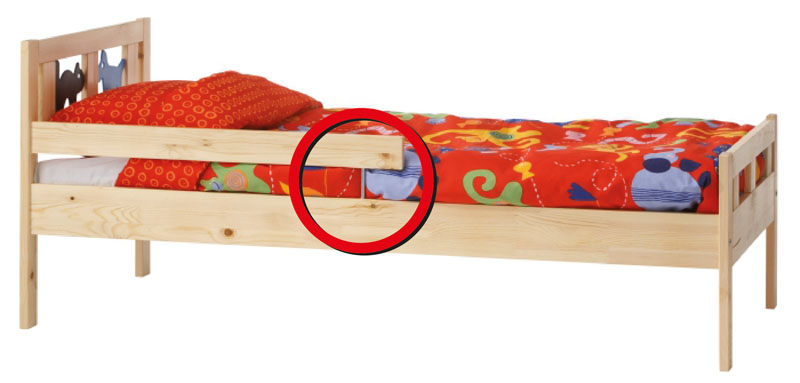
IKEA Recalls Junior Beds Due to Laceration Hazard


Consumers should stop using this product unless otherwise instructed. It is illegal to resell or attempt to resell a recalled consumer product.
Recall date: August 15, 2013
Recall number: 13-266 
 
If you or someone you know has been injured by this product or any other product, contact the Vogel Law Firm immediately for a free evaluation of your case. Call 865-357-1949 or email: rlvogel@robertvogellaw.com.


Recall Summary

Name of product:
KRITTER and SNIGLAR Junior Beds
Hazard:
The metal rod connecting the guard rail to the bed frame can break in use, posing a laceration hazard


Units
About 22,000 in U.S. and 18,000 in Canada
Description
These recalled IKEA junior beds include the KRITTER and SNIGLAR models with a guard rail on one side. The pine wood KRITTER beds have animal cut-outs, such as a dog and cat on the headboard and a date stamp of 1114 to 1322 representing the year and week of production (YYWW). The SNIGLAR natural beech wood beds have a white painted fiberboard insert on the headboard and footboard of the bed and a date stamp of 1114 to 1318. The beds measure about 65 inches long by 30 inches wide with a 22 to 26 inch high headboard. The date stamp appears on a label attached to either the headboard or the underside of the bed. Model numbers included in the recall are 600.904.70 for the KRITTER and 500.871.66 for the SNIGLAR, supplier number 15361 (KRITTER) and 19740 or 18157 (SNIGLAR) printed on the same label as the date stamp.
Incidents/Injuries
There has been one report in the U.S. and one report in Canada of the metal rod on the beds breaking. No injuries have been reported. 

Remedy
Consumers should immediately stop using the recalled KRITTER and SNIGLAR junior beds and contact IKEA to receive a free repair kit.
Sold exclusively at
IKEA stores nationwide and online at www.ikea-usa.com from July 2005 through May 2013 for between $60 and $90.
Importer
IKEA North America Services LLC, of Conshohocken, Pa.
Manufactured in
Poland, Bosnia Herzegovina and Romania