Showing posts with label consumer protection. Show all posts

Monday, February 10, 2014

Beware of Forced Arbitration Clauses

Attorney Bob Vogel can be contacted at rlvogel@robertvogellaw.com or by calling 865-357-1949

 
By opening a credit card envelope in the mail, making a call on a cell phone, or even

taking a first sip of coffee, millions of American consumers are unknowingly giving
 
up their rights and protections established by more than 200 years of constitutional

law. Instead they unwittingly “agree” to the terms and conditions of a corporate backed

privatized system designed to ensure consumers can never hold corporations

accountable for causing harm, no matter how abusive or horrific.


Forced arbitration is Corporate America’s Trojan Horse – a campaign to eliminate access

to the courts and individual rights and replace them with big businesses’ own dispute

mill. Though most Americans remain largely unaware of forced arbitration and its effects

on their rights, more than half a billion arbitration provisions infi ltrate our everyday lives.

Forced arbitration clauses are bad news for consumers, patients and workers.
Arbitration can be an effective solution in business-to-business cases, when
corporations with vast legal resources and knowledge voluntarily agree to settle

with arbitration. But in the David versus Goliath context of an individual taking on a

corporation, forcing people into arbitration is little more than stealing their right to

justice. The otherwise benign-sounding idea of arbitration is actually a severely biased

process in which you can almost never win, and from which you can never escape. As

Senator Elizabeth Warren once said, forced arbitration is “Darth Vader’s Death Star--the

Empire always wins.”

Most Americans have “consented” to a wide range of forced arbitration clauses without

ever knowing it.
 

Forced arbitration eliminates all of the checks and balances of the civil justice system,

including the right to a public forum, the right to demand information from a

corporation, the right to a written record, and, most importantly, the right to trial by jury.

Arbitrators are not bound by law and their decisions are not subject to any meaningful

judicial review.

At every stage this Trojan Horse has been pushed by the fi nancial and lobbying might


of the U.S. Chamber of Commerce. Through its legal reform front group the Institute

for Legal Reform (ILR), the U.S. Chamber has been at the forefront of a heavily-funded

campaign to eliminate corporate accountability, even for massive violations of state and

federal law. For decades, this has primarily revolved around high profi le PR campaigns


to portray the civil justice system as beset by frivolous lawsuits. But where a billiondollar

tort reform campaign has not succeeded in closing the courthouse door, its more

stealthy compatriot – forced arbitration – has gone a long way to shielding corporations

from accountability and replacing the courthouse altogether.
 

Consumer forced arbitration clauses have surged in the last two decades as

corporations have pounced on the opportunities they present. To Big Business, the

boilerplate clauses are the ultimate out. Accountability for all misconduct and violations

of law has been eliminated by a paragraph of fi ne print that is rarely ever read. Without


realizing it, the majority of Americans have consented to forced arbitration multiple

times.1

These clauses are buried in the fi ne print of credit card

and cell phone contracts, in the packaging of every

imaginable retail product, and in mountainous pages of

nursing home care and employment contracts. Often,

consumers are unaware that they have agreed to a

forced arbitration clause. Corporations conduct extensive

market research to design these notices in a way that

makes them easy to ignore, with headers such as “there’s

nothing you need to do.”3 Researchers have shown that

it is next to impossible to see these forced arbitration

clauses before applying for a credit card or purchasing

a product, which means just by “receiving” the product

or service, one is “agreeing” to sign away all legal rights

and protections. Nor do consumers gain anything from

“agreeing” to waive their rights. Consumers do not get

better rates, faster service or enjoy any other form of

passed-on savings.


Even using a website can bind you to forced arbitration.

Sites such as PayPal, EBay, and Instagram use broad

forced arbitration clauses. Instagram’s forced arbitration

clause went so far as to ban users from participating

in actions by state attorneys general. Under such a provision, site visitors whose credit

card details were leaked would be unable to benefi t from any intervention by state

authorities.

Arbitration’s defenders claim it is more effi cient and less costly than the civil justice


system. If this were true, arbitration would not have to be forced on mostly
 
unwitting consumers. The truth is the U.S. Chamber’s forced arbitration campaign has


been nothing less than a rights grab of unprecedented sweep. Millions of Americans
 
have had their constitutional protections stripped away by boilerplate fi ne print slipped


into every imaginable contract.

With their accountability eliminated, corporations have found themselves free to cheat

and abuse customers and employees, encouraged by the fact that such abuses have

gone unchecked. And without a public record of theses abuses, Americans will have no

way of knowing just how much danger these products and services pose. When no one

is accountable, no one is safe.

 
While courts across the land have attempted to stand up to the unfairness of forced

arbitration, such attempts at preserving protections have been stymied by the U.S.

Supreme Court. The Court’s consistent message has been that individuals, groups, and

states will not be allowed to circumvent the FAA no matter how virtuous their cause.

This means that any respite from the abuses of forced arbitration lies with Congress and

federal agencies. Without Congressional action, corporations will use forced arbitration

for what it is – a license to steal.


Contact Attorney Bob Vogel for information about your rights. rlvogel@robertvogellaw.com
 

Thursday, January 9, 2014

U.S. Boiler Recalls Home Heating Boilers Due to Carbon Monoxide Hazard

Consumers should stop using this product unless otherwise instructed. It is illegal to resell or attempt to resell a recalled consumer product.

Hazard:

The air pressure switch can fail to shut down the burners when there is a blockage in the vent system, allowing the boiler to emit excessive amounts of carbon monoxide and posing a CO poisoning hazard to the consumer

The following report was issued on 1/9/14. If you have been injured by this product, or any other product, contact The Vogel Law Firm immediately for assistance. 865-357-1949, or email: Karen@robertvogellaw - You will receive a free consultation and case evaluation.


Recall date: January 09, 2014
Recall number: 14-076                    
      

Recall Summary

Name of product:
Gas-fired hot water boilers
                           

Units
About 26,000 in the United States and about 310 in Canada
Description
This recall involves U.S. Boiler ESC, PVG and SCG model cast iron hot water boilers that use natural gas or liquid petroleum to heat water for residential space heating. The boilers are light blue in color with black trim, about 40 inches tall, about 26 inches deep and range from 12 to 31 inches wide. The model name and U.S. Boiler logo are on the front cover of the boiler. The front cover of the boiler is vented. Recalled boilers were manufactured between December 2005 and February 2013. The model number, serial number and manufacturing date are located on a silver label on the top panel of ESC models and on the inside of PVG and SCG models on the right side panel. The manufacturing date appears in the upper right corner of the silver label in the MM/YYYY format.  The following model numbers and serial number ranges are included in this recall:

Model NumberSerial Number Range
ESC3 through ESC965249110 through 65382278
PVG3_P, PVG4_P and PVG5 through PVG964870666 through 65385748; 97939433
SCG3 through SCG935200197; 65283322 through 65858729
Incidents/Injuries
None reported
Remedy
Consumers with recalled boilers should immediately contact the installer or distributor from whom they purchased the boiler or U.S. Boiler to schedule a free in-home safety inspection and repair. Consumers who continue use of the boilers while awaiting repair, should have a working carbon monoxide alarm installed outside of sleeping areas in the home.
Sold at
Plumbing and heating wholesale distributors nationwide from December 2005 through February 2013 for between $1,700 and $4,900.
Manufacturer
U.S. Boiler Company Inc., of Lancaster, Penn.
Manufactured in
United States

Thursday, October 24, 2013

Emerson Air Comfort Products Recalls Tommy Bahama Outdoor Ceiling Fans Due to Risk of Injury

There have been incidents of the blades detaching and causing lacerations. My law firm helps people who are injured by a product or service. Please call Robert L. Vogel, The Vogel Law Firm, 865-357-1949  or write rlvogel@robertvogellaw.com for a free case evaluation. We are a consumer protection law firm.

Consumers should stop using this product unless otherwise instructed. It is illegal to resell or attempt to resell a recalled consumer product.
Recall date: October 24, 2013
Recall number: 14-005                         
 
Emerson Air Comfort Tommy Bahama-brand Outdoor Ceiling Fan                           

Recall Summary

Name of product:
Tommy Bahama® Outdoor Ceiling Fans
Hazard:
The brackets holding the fan blades can break and cause the blades to fall, posing a risk of injury to bystanders.
Consumer Contact:
Emerson Air Comfort Products toll-free at (866) 994-8759 from 8 a.m. to 4:30 p.m. CT Monday through Friday, or online at www.emersonfans.com, then click on Recall Information for more information.
Report an Incident Involving this Product

Recall Details

Units
About 2,800 in the United States, 80 in Canada
Description

This recall involves Tommy Bahama brand 52-inch outdoor ceiling fans sold under the “The Copa Breeze” style name. The fan has model number TB311DBZ and a distressed bronze color. Each of the five oval-shaped paddles/blades has a metal accent in the shape of an oval with a figure-8 inside the oval.  The lower part of the motor housing has “Tommy Bahama” embossed on it.  A date code is represented by three letters printed on the lower right corner of a label on the top of the motor housing. Fans with one of the following three-letter combinations are included in the recall:
  
AJL, BAA, BAB, BAC, BAD, BAE, BAF,BAG, BAH, BAI, BAJ, BAK, BAL, BBA, BBB, BBC, BBD, BBE, BBF, BBG, BBH, BBI, BBJ, BBK, BBL, BCA, BCB, BCC and BCD
This recall involves Tommy Bahama brand 52-inch outdoor ceiling fans sold under the “The Copa Breeze” style name. The fan has model number TB311DBZ and a distressed bronze color. Each of the five oval-shaped paddles/blades has a metal accent in the shape of an oval with a figure-8 inside the oval.  The lower part of the motor housing has “Tommy Bahama” embossed on it.  A date code is represented by three letters printed on the lower right corner of a label on the top of the motor housing. Fans with one of the following three-letter combinations are included in the recall:  AJL, BAA, BAB, BAC, BAD, BAE, BAF,BAG, BAH, BAI, BAJ, BAK, BAL, BBA, BBB, BBC, BBD, BBE, BBF, BBG, BBH, BBI, BBJ, BBK, BBL, BCA, BCB, BCC and BCD
Incidents/Injuries
Emerson Air Comfort has received three reports of fan blades detaching, including one report of a laceration to a consumer who was hit in the back of the head by a falling blade.
Remedy
Consumers should immediately stop using the recalled fans and contact Emerson Air Comfort Products to schedule a free in-home repair or to order a free do-it-yourself repair kit.
Sold at
Fan and lighting stores nationwide and online at www.EmersonFans.com and Amazon.com from April 2010 through July 2012 for about $350.
Importer
Air Comfort Products, a division of Emerson Electric Co., of St. Louis, Mo
Manufactured in
China

Monday, October 21, 2013

Watch Out for These Weight Loss Lies!

The big question is, of course: Will I Really Lose Weight?

Wouldn’t it be nice if you could lose weight simply by taking a pill, wearing a patch, or rubbing in a cream? Unfortunately, claims that you can lose weight without changing your habits just aren’t true.
Doctors, dieticians, and other experts agree that the best way to lose weight is to eat fewer calories and be more active. That's true even for people taking FDA-approved pills to help them lose weight. For most people, a reasonable goal is to lose about a pound a week, which means:
  • cutting about 500 calories a day from your diet
  • eating a variety of nutritious foods
  • exercising regularly
For more on healthy eating, visit Nutrition.gov, ChooseMyPlate.gov, or the Weight-control Information Network.

The following article first appeared on the FTC consumer information pages. I've tried different fads and diets over the years. There is a lot of wisdom in the information that follows. It is very important to get to and stay at a healthy weight. And there are many studies that prove that being healthy and getting regular exercise can stave off the aging process and dementia. Keeping your brain active is important to, and when you are physically active, your are more mentally active.

I hope this information helps you avoid some scams and traps and the you find the right plan for yourself.

If, after reading this article, you feel that you have been taken advantage of by a product or service - whether it is a diet or exercise product or program, call me. I handle all types of consumer protection and fraud cases.

Bob Vogel
Trial Attorney
The Vogel Law Firm
rlvogel@robertvogellaw.com
865-357-1949

The Truth Behind Weight Loss Ads

Claims to watch out for include:

Lose weight without diet or exercise!

Getting to a healthy weight takes work. Take a pass on any product that promises miraculous results without the effort. The only thing you’ll lose is money.

Lose weight no matter how much you eat of your favorite foods!

Beware of any product that claims that you can eat all the high-calorie food you want and still lose weight. Losing weight requires sensible food choices. Filling up on healthy vegetables and fruits can make it easier to say no to fattening sweets and snacks.

Lose weight permanently! Never diet again!

Even if you’re successful in taking weight off, permanent weight loss requires permanent lifestyle changes. Don’t trust any product that promises once-and-for-all results without ongoing maintenance.

Just take a pill!

Doctors, dieticians, and other experts agree that there’s simply no magic way to lose weight without diet or exercise. Even pills approved by FDA to block the absorption of fat or help you eat less and feel full are to be taken with a low-calorie, low-fat diet and regular exercise.

Lose 30 pounds in 30 days!

Losing weight at the rate of a pound or two a week is the most effective way to take it off and keep it off. At best, products promising lightning-fast weight loss are a scam. At worst, they can ruin your health.

Everybody will lose weight!

Your habits and health concerns are unique. There is no one-size-fits-all product guaranteed to work for everyone. Team up with your health care provider to design a nutrition and exercise program suited to your lifestyle and metabolism.

Lose weight with our miracle diet patch or cream!

You’ve seen the ads for diet patches or creams that claim to melt away the pounds. Don’t believe them. There’s nothing you can wear or apply to your skin that will cause you to lose weight.

Acai Berry Supplements in the “News”

More and more, scam artists are exploiting people’s trust in well-known news organizations by setting up fake news sites with the logos of legitimate news organizations to peddle their wares. In particular, sites claiming to be objective news sources may describe a so-called "investigation" of the effectiveness of acai berry dietary supplements for weight loss. These sites are a marketing ploy created to sell acai berry supplements.

Tainted Weight Loss Products

In the last few years, FDA has discovered hundreds of dietary supplements containing drugs or other chemicals, often in products for weight loss and bodybuilding. These extras generally aren't listed on the label — and might even be sold with false and misleading claims like “100% natural” and “safe.” They could cause serious side effects or interact in dangerous ways with medicines or other supplements you're taking.

The Skinny on Electronic Muscle Stimulators

You might have seen ads for electronic muscle stimulators claiming they will tone, firm, and strengthen abdominal muscles, help you lose weight, or get rock hard abs. But according to FDA, while these devices may temporarily strengthen, tone, or firm a muscle, no electronic muscle stimulator device alone will give you “six-pack” abs.

Where to Complain

Report fraudulent weight loss product claims to the FTC. You also can contact your state Attorney General

Feel free to contact me with questions or concerns. Bob Vogel - rlvogel@robertvogellaw.com

Sunday, October 20, 2013

How to Avoid Tech Support Scams

The following article is reprinted from the Consumer Protection Website. I hope that this helps you avoid scams and con artists. It is frightening the number of people out there trying to exploit you on the internet. Take the advise from this article and make your time a little safer on the internet and avoid losing your money to any of these scams.

I hope this helps,

Bob Vogel
The Vogel Law Firm
865-357-1949
rlvogel@robertvogellaw.com
www.robertvogellaw.com

 How Tech Support Scams Work

Scammers have been peddling bogus security software for years. They set up fake websites, offer free “security” scans, and send alarming messages to try to convince you that your computer is infected. Then, they try to sell you software to fix the problem. At best, the software is worthless or available elsewhere for free. At worst, it could be malware — software designed to give criminals access to your computer and your personal information.
The latest version of the scam begins with a phone call. Scammers can get your name and other basic information from public directories. They might even guess what computer software you’re using.
Once they have you on the phone, they often try to gain your trust by pretending to be associated with well-known companies or confusing you with a barrage of technical terms. They may ask you to go to your computer and perform a series of complex tasks. Sometimes, they target legitimate computer files and claim that they are viruses. Their tactics are designed to scare you into believing they can help fix your “problem.”
Once they’ve gained your trust, they may:
  • ask you to give them remote access to your computer and then make changes to your settings that could leave your computer vulnerable
  • try to enroll you in a worthless computer maintenance or warranty program
  • ask for credit card information so they can bill you for phony services — or services you could get elsewhere for free
  • trick you into installing malware that could steal sensitive data, like user names and passwords
  • direct you to websites and ask you to enter your credit card number and other personal information
Regardless of the tactics they use, they have one purpose: to make money.

If You Get a Call

If you get a call from someone who claims to be a tech support person, hang up and call the company yourself on a phone number you know to be genuine. A caller who creates a sense of urgency or uses high-pressure tactics is probably a scam artist.
Keep these other tips in mind:
  • Don’t give control of your computer to a third party who calls you out of the blue.
  • Do not rely on caller ID alone to authenticate a caller. Criminals spoof caller ID numbers. They may appear to be calling from a legitimate company or a local number, when they’re not even in the same country as you.
  • Online search results might not be the best way to find technical support or get a company’s contact information. Scammers sometimes place online ads to convince you to call them. They pay to boost their ranking in search results so their websites and phone numbers appear above those of legitimate companies. If you want tech support, look for a company’s contact information on their software package or on your receipt.
  • Never provide your credit card or financial information to someone who calls and claims to be from tech support.
  • If a caller pressures you to buy a computer security product or says there is a subscription fee associated with the call, hang up. If you’re concerned about your computer, call your security software company directly and ask for help.
  • Never give your password on the phone. No legitimate organization calls you and asks for your password.
  • Put your phone number on the National Do Not Call Registry, and then report illegal sales calls.

If You’ve Responded to a Scam

If you think you might have downloaded malware from a scam site or allowed a cybercriminal to access your computer, don’t panic. Instead:
  • Get rid of malware. Update or download legitimate security software and scan your computer. Delete anything it identifies as a problem. 
  • Change any passwords that you gave out. If you use these passwords for other accounts, change those accounts, too.
  • If you paid for bogus services with a credit card, call your credit card provider and ask to reverse the charges. Check your statements for any other charges you didn’t make, and ask to reverse those, too.
  • If you believe that someone may have accessed your personal or financial information, visit the FTC’s identity theft website. You can minimize your risk of further damage and repair any problems already in place.
  • File a complaint with the FTC at ftc.gov/complaint.

Thursday, August 15, 2013

IKEA Recalls Junior Beds Due to Laceration Hazard


Consumers should stop using this product unless otherwise instructed. It is illegal to resell or attempt to resell a recalled consumer product.
Recall date: August 15, 2013
Recall number: 13-266 
 
If you or someone you know has been injured by this product or any other product, contact the Vogel Law Firm immediately for a free evaluation of your case. Call 865-357-1949 or email: rlvogel@robertvogellaw.com.


Recall Summary

Name of product:
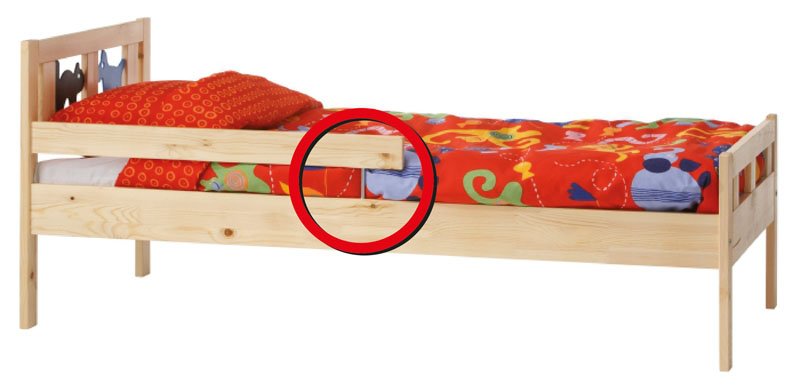
KRITTER and SNIGLAR Junior Beds
Hazard:
The metal rod connecting the guard rail to the bed frame can break in use, posing a laceration hazard


Units
About 22,000 in U.S. and 18,000 in Canada
Description
These recalled IKEA junior beds include the KRITTER and SNIGLAR models with a guard rail on one side. The pine wood KRITTER beds have animal cut-outs, such as a dog and cat on the headboard and a date stamp of 1114 to 1322 representing the year and week of production (YYWW). The SNIGLAR natural beech wood beds have a white painted fiberboard insert on the headboard and footboard of the bed and a date stamp of 1114 to 1318. The beds measure about 65 inches long by 30 inches wide with a 22 to 26 inch high headboard. The date stamp appears on a label attached to either the headboard or the underside of the bed. Model numbers included in the recall are 600.904.70 for the KRITTER and 500.871.66 for the SNIGLAR, supplier number 15361 (KRITTER) and 19740 or 18157 (SNIGLAR) printed on the same label as the date stamp.
Incidents/Injuries
There has been one report in the U.S. and one report in Canada of the metal rod on the beds breaking. No injuries have been reported. 

Remedy
Consumers should immediately stop using the recalled KRITTER and SNIGLAR junior beds and contact IKEA to receive a free repair kit.
Sold exclusively at
IKEA stores nationwide and online at www.ikea-usa.com from July 2005 through May 2013 for between $60 and $90.
Importer
IKEA North America Services LLC, of Conshohocken, Pa.
Manufactured in
Poland, Bosnia Herzegovina and Romania